Single-Farm Bilona Ghee
Single Farm Bilona A2 Cow Ghee
Made only from milk of our own indigenous Gir/Sahiwal cows and farm-raised buffaloes
- No pooled milk
- No external sourcing
- Limited by nature
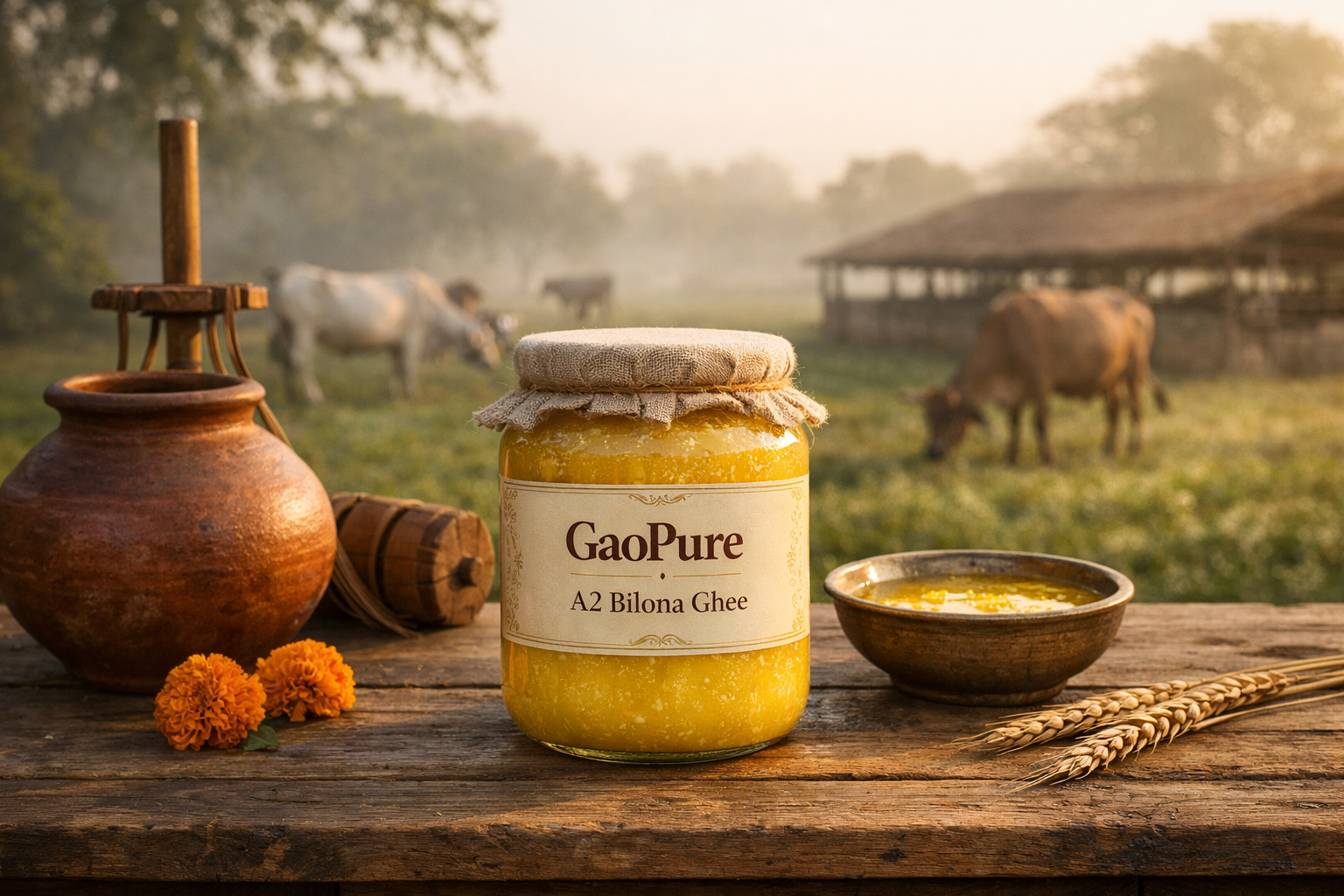
Single-Farm Bilona Ghee
Made only from milk of our own indigenous Gir/Sahiwal cows and farm-raised buffaloes
Farmers, not traders — from our farm in Rampur, UP
We are farmers. Not traders, not middlemen, not a brand that sources from multiple dairies.
GaoPure ghee is prepared only from milk produced on our own farm in Rampur, Uttar Pradesh. Our indigenous Gir/Sahiwal cows and buffaloes are raised here, fed here, and cared for by us. The milk never leaves our oversight from animal to jar.
This is not a business model designed for scale. It is simply how our family has always made ghee — with complete control over every step, and complete honesty about what we can and cannot produce.
A traditional process that transforms 25-30 litres of milk into 1 litre of ghee
A traditional technique where curd is hand-churned using a wooden churner (bilona) to extract butter, which is then slow-cooked to create pure, aromatic ghee. This preserves all nutrients and gives ghee its distinctive grainy texture and rich aroma.
Fresh milk collected from our Gir/Sahiwal cows and buffaloes, raised on natural pastures. Calves are always fed first.
Milk is boiled and set into thick, creamy curd using traditional culture — no artificial starters.
Curd is hand-churned using a wooden bilona in a bi-directional motion to extract fresh makhan (butter).
Makhan is slow-cooked on low flame for hours, allowing milk solids to separate naturally.
Clear, golden ghee is filtered and collected. The process is complete when the ghee develops its characteristic aroma.
It takes approximately 25-30 litres of milk to produce 1 litre of Bilona ghee. This is a slow, labor-intensive process.
Understanding the difference in milk sources
Indigenous Indian cow breeds — such as Gir, Sahiwal, and Tharparkar — naturally produce milk containing A2 beta-casein protein. This is different from many foreign breeds that produce A1 protein.
Research suggests A2 protein may be easier to digest for some people. Our cow ghee is made exclusively from milk of our Gir/Sahiwal cows, making it naturally A2.
We mention this as fact, not as a marketing claim. We do not suggest A2 ghee cures or prevents any condition.
Buffalo milk is naturally different from cow milk. It has higher fat content, a richer texture, and has been traditionally used in Indian households for centuries.
Buffalo ghee is white to pale cream in color (unlike the yellow of cow ghee) and has a distinct, slightly heavier taste preferred for sweets, parathas, and everyday cooking.
We raise indigenous Gir/Sahiwal cows and buffaloes on our farm, offering ghee from each separately based on your preference.
What ghee contains and how it has been traditionally used
Contains fat-soluble vitamins A, D, E, and K — essential for immunity, bone health, and skin.
Contains butyric acid, traditionally associated with supporting gut health and digestive wellness.
Traditionally consumed as a source of stable cooking fat and daily nourishment.
In Ayurveda, ghee is associated with supporting digestive fire and nutrient absorption.
The clarification process removes milk solids — suitable for those with dairy sensitivities.
Traditionally used by growing children, adults, and elders as part of daily nourishment.
Commonly used in cooking, daily routines, and traditional practices
High smoke point makes it perfect for everyday Indian cooking
Adds authentic flavor to dals, sabzis, and traditional dishes
A spoonful daily as part of traditional wellness routines
Pure ghee for diyas and sacred rituals as per traditions
Natural moisturizer for soft skin and lustrous hair
Gentle and nourishing for infant massage routines
Two types of ghee, each made through the same Bilona process
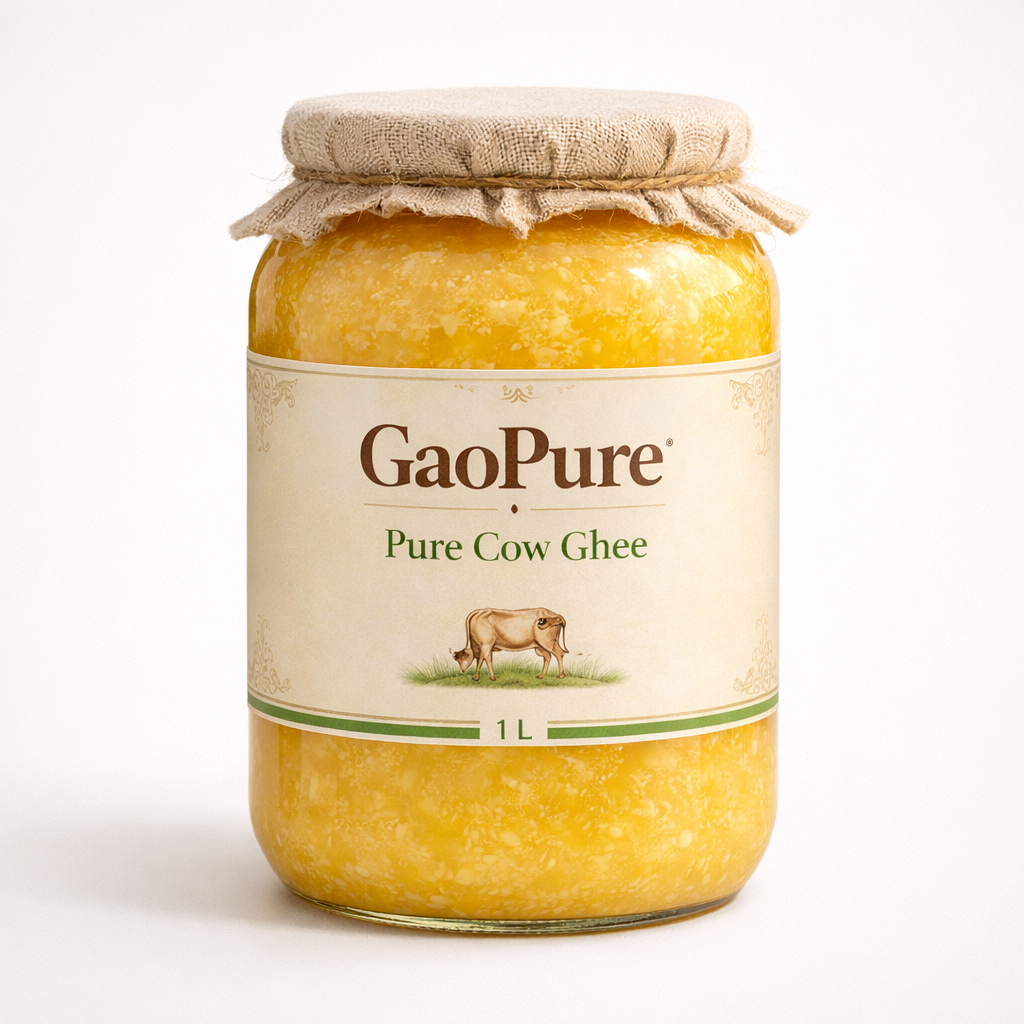
Made from milk of our indigenous Gir/Sahiwal cows. Golden yellow color with a mild, sweet aroma. Naturally A2.
Small-batch preparation. Glass jar packaging. Batch date shared at time of confirmation.
Check current batch availability on WhatsApp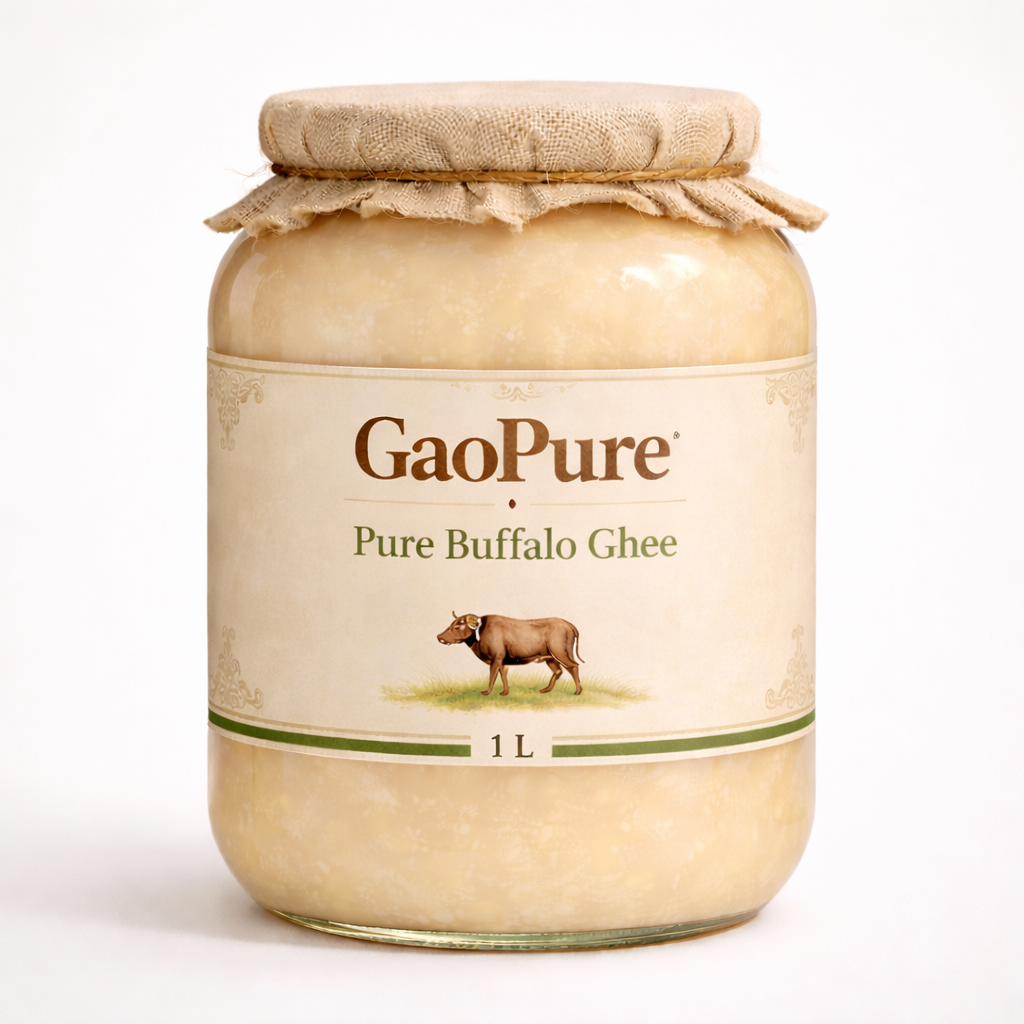
Made from milk of our own farm-raised buffaloes. White to pale cream color with a rich, full-bodied taste. Higher fat content.
Small-batch preparation. Glass jar packaging. Batch date shared at time of confirmation.
Check current batch availability on WhatsAppHow we work and what we do not compromise on
All milk comes from animals raised on our own farm. No external purchasing, no pooled sources.
Production is limited by what our farm produces. We maintain waitlists rather than compromise sourcing.
Our animals graze freely, are cared for throughout their lives. Calves are never separated and always fed first.
No hormones or growth stimulants. Our animals produce what they naturally produce.
Pure ghee with no additives. Properly made ghee has a natural shelf life of 12-18 months.
No cream separators, no machine churning, no rapid heating. Full traditional Bilona process only.
We do not increase production beyond what our farm allows. This is not a limitation we apologize for — it is a principle we operate by.
Everything you need to know about our ghee
Cow ghee is golden yellow in color, has a lighter texture, and a mild, slightly sweet aroma. It is traditionally considered more suitable for daily consumption and religious purposes.
Buffalo ghee is white to pale cream in color, has a richer and heavier texture, and a more pronounced taste. It has higher fat content and is traditionally preferred for sweets, parathas, and dishes where a richer flavor is desired.
Both are equally pure when made traditionally. The choice depends on your taste preference and intended use.
Bilona refers to the wooden churning rod traditionally used to churn curd. The Bilona method is a process where whole milk is first set into curd, then hand-churned using this wooden rod to extract butter, which is then slow-cooked into ghee.
This is different from the industrial method where cream is separated from milk using machines, then directly converted to butter and ghee. The Bilona method is more time-consuming and yields less ghee, but it is the traditional way ghee has been made in Indian households.
Store the ghee in a cool, dry place away from direct sunlight. Refrigeration is not necessary — pure ghee is shelf-stable at room temperature.
Always use a clean, dry spoon when taking ghee from the jar. Moisture or food particles can reduce shelf life.
Our ghee has a shelf life of 12-18 months when stored properly. In winter, the ghee may become grainy or solidify — this is natural and does not affect quality. It will return to a smoother texture in warmer temperatures.
The clarification process that converts butter into ghee removes milk solids, which contain lactose and casein. What remains is almost entirely pure butterfat with negligible lactose content.
Many people with lactose intolerance find that they can consume ghee without the digestive issues they experience with other dairy products.
However, if you have a severe dairy allergy (as opposed to lactose intolerance), please consult your doctor before consuming ghee, as trace amounts of milk proteins may remain.
Our production is limited by what our farm produces. We prepare ghee in small batches as milk becomes available.
When you contact us on WhatsApp, we will let you know current availability. If the product you want is available, we can arrange delivery. If it is not currently available, we can add you to our waitlist and notify you when the next batch is ready.
We do not take orders beyond what we can fulfill from our own production. Wait times vary depending on season and demand.
No. We do not increase production beyond what our farm produces. If a batch is unavailable, we wait for the next preparation cycle.
We do not purchase milk from other farms, dairies, or collection centers under any circumstances. This is a principle we do not compromise on.